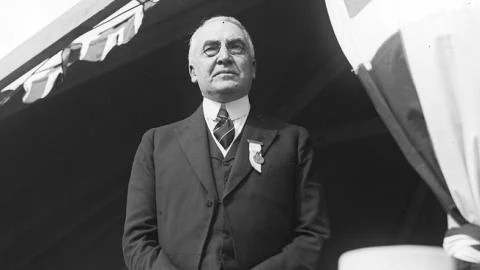
Warren Harding has been repeatedly trashed by historians as a man with no accomplishments in office. Bill O’Reilly and Martin Dugard repeat the oft-used lie, portraying Harding as someone who never really distinguished himself in politics. The historical record says otherwise.
They write in Confronting the Presidents:
“Warren G. Harding is not a hard worker. Never has been. In fact, he rarely reads briefing papers and depends on his so-called Ohio Gang for advice. This insider group of politicians and industrialists grows to eleven during his administration. Not all are from Ohio, but Harding has cultivated their support. The one thing that binds these men together is their placing personal needs before those of the nation.”
From my book, Jazz Age President:
“William H. Crawford, a reporter who spent a week observing Harding in the White House, wrote that the president breached ‘the eight-hour law twice every day, his usual day lasting about seventeen hours.’ A typical workweek for President Harding was eighty-four hours, Crawford noted. White House workers confirmed these observations, according to Louis Ludlow, who wrote, ‘Mr. Harding put in more hours of toil per day, on the average, and more hours in the aggregate, than any other President within their recollection.’”
As for Harding’s accomplishments, or lack thereof, O’Reilly/Dugard write:
“Many historians consider Warren Harding to be one of America’s worst presidents. He was overwhelmed by the demands of the office, so much so that he placed the good of the nation in the hands of corrupt people while he abdicated the discipline of leadership.
“Warren Gamaliel Harding constructed no lasting legislation and did not leave a positive legacy.
“A cynic might say he dealt from the bottom of the deck in every way.”
Yet this is simply a lack of knowledge about Warren Harding. The authors apparently know nothing about the man or his presidency.
Here is what I consider Harding’s major achievements:
He revived the American economy and paved the way for the most prosperous decade in U.S. history, an economic expansion that aided every class of citizen. He reduced both taxes and government spending, thereby lessening the burdens on the people. He created the Budget Bureau, which gave the federal government a comprehensive budget for the first time.
He restored domestic tranquility, ushering in an era of peace and prosperity. He pardoned war resisters. He pushed for anti-lynching legislation (which passed the House) and urged equal rights for black Americans—the first president of the twentieth century to do so.
He created the Veterans Bureau to help the hundreds of thousands of wounded American servicemen returning from France. He appointed four justices to the Supreme Court to safeguard the Constitution. He transformed the vice presidency into its modern role in government.
He called the Washington Disarmament Conference and achieved reductions in the world’s deadliest weapons, twice receiving the nomination for a Nobel Peace Prize. He formally ended World War I, withdrew American troops from the Caribbean and from the Rhineland in Germany, and improved relations with Mexico and Latin America. He called the World War Foreign Debts Commission to hammer out an agreement on war debt and provided aid to millions of famine victims in Russia.
And all of it in less time than President John F. Kennedy was in office.
Consider: Warren Harding served just 882 days in office, a length of time that is comparable to Kennedy’s 1036 days. It is a comparison I noted in Jazz Age President. But Harding had a far more superior presidency than did JFK.
As author, and fellow Harding defender, James D. Robenalt has noted: “John Kennedy was president for almost the same length of time as Warren Harding, but his record was decidedly mixed: Disasters such as the Bay of Pigs and involvement in Vietnam weigh against successes such as the handling of the Cuban missile crisis and the nuclear test ban treaty. Yet history could not have treated these two men more differently. Kennedy became an icon; Harding was deemed a failure.”
The Harding-Kennedy ranking says much more about those making the comparisons than the actual facts that should be compared.
 Ryan S. Walters
Leave a comment