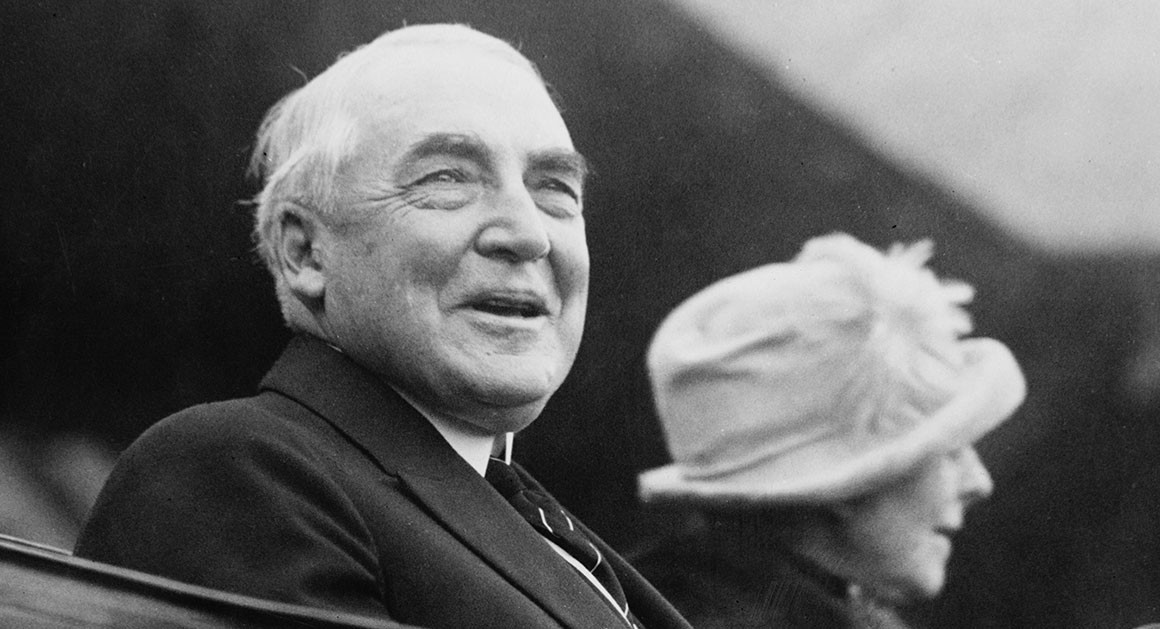
I recently purchased the newest book by Bill O’Reilly and Martin Dugard entitled Confronting the Presidents: No Spin Assessments from Washington to Biden. I love presidential history and have dozens of volumes on ratings and surveys of our chief executives, some good, others not so much.
I wasn’t expecting much from O’Reilly, certainly not an honest critique of our more conservative presidents, and I wasn’t disappointed in that regard. And, as a very rare defender of Warren Harding, I was more than disappointed when I peered into that chapter.
For starters, the authors do not cite any sources in the book. There are no notes and no bibliography, so where they got their information is anyone’s guess. And it is not a typical “presidential rankings” work. There is one chapter for each president in chronological order yet at the end of each chapter the authors given an assessment of sorts: “Abraham Lincoln was perhaps the greatest president.” “History has not been kind to James Buchanan, and that is fair.”
The first indication that O’Reilly and Dugard would take a standard, negative approach to Warren Harding was at the end of their chapter on Woodrow Wilson.
“Despite the hardship of his last months in office, Woodrow Wilson left a legacy of turning the United States from an isolationist nation into a world power. He enacted the regulatory reform of monetary policies through the creation of the Federal Reserve. And he transformed the Democrats from a party mired in Civil War-era southern politics into one bent on progressive reform. Although not in terms of civil rights.
“As the nation enters the so-called Roaring Twenties, the new president is a man with no agenda, no plan, and few scruples. It is Harding time.”
It went downhill from there. So allow me to compare the O’Reilly/Dugard take on Warren Harding with my assessment in my book, Jazz Age President: Defending Warren G. Harding.
The O’Reilly/Dugard chapter on Harding began with, what else, his personal life.
“The man with no moral compass is now running the country,” they write.
“‘Forget that I’m president of the United States,’ says the nation’s twenty-ninth chief executive to his fellow poker players. Saturday night. Second-floor residence. Seven powerful guests, known as the ‘Poker Cabinet,’ are seated at the table. ‘Cards and chips ready at hand – a general atmosphere of waistcoast unbuttoned, feet on the desk, and spittoons alongside,’ one attendee remembers.
“Profanity. Whiskey, Tobacco. …
“‘I’m Warren Harding, playing poker with friends,’ says the president. ‘And I intend to beat them.’”
This early scene caught my eye. For one thing, the writers mingled together two quotes from two different sources as if describing one event. They don’t.
One quote came from Edmund Starling, chief Secret Service agent for Harding. And he was talking about golf, not poker. “Forget that I am President of the United States. I’m Warren Harding, playing with some friends, and I’m going to beat hell out of them.”
The other quote came from Alice Longworth Roosevelt, eldest child of Teddy, who did not like Harding and did not spend very much time in the White House with him, so she’s hardly able to tell us how often such gatherings took place.
From Jazz Age President:
On the subject of the poker games, Alice Roosevelt Longworth described the White House as having “the general atmosphere of a convivial gambling saloon.” But Agent Edmund Starling, who “attended all of these gatherings,” had a different take. At no time did he ever see “the slightest sign of debauch,” he wrote. “The stakes were modest, since these men played purely for the sport of it. How could Andy Mellon, for instance, get a kick out of winning money in a poker game? They played with great zest and good humor, drank moderately and sociably, and smoked—all in the best tradition of the Elks Club.”
In fact, by 1923 Harding had quit the poker games and even stopped drinking.
O’Reilly and Dugard also lied about Harding having mistresses in the White House:
“But the Secret Service does [know about Harding’s secret life] because, at Harding’s orders, it sneaks women into the West Wing.”
“Instead of governance, he spends his days playing golf or having sex with Nan Britton in a secret West Wing location. The Secret Service knows to smuggle her in when Flossie [First Lady Florence] is not watching.”
This is a blatant falsehood, as primary sources easily refute it. Three accounts from persons who worked in the Harding White House, including the chief of the Secret Service, proves this is a smear.
(Of course, we know that Harding had a relationship with Britton that produced a child, as DNA revealed it recently, but they had NO liaison in the White House)
Jazz Age President:
White House doorkeeper Patrick Kenney stated that he “had never heard of Nan Britton,” had “never admitted any woman by such a name,” and that “no strange woman ever came to see President Harding.” Ike Hoover, who was the supposed source for Alice Roosevelt Longworth, refuted the whole sordid tale of Oval Office affairs, stating matter-of-factly, “There was never a gadabout by that name or any other name in the White House. Nan Britton is a liar.” Secret Service agent Edmund Starling said no such rendezvous with Britton or any other woman ever happened, “not while he was at the White House. That I know for certain.” Beyond what he could speak to from his own direct knowledge, Starling was skeptical that Harding had ever had an affair with Britton, noting in his memoirs that the very idea of the president “pursuing her is something no one who knew him would believe.” “If it happened,” Starling wrote, “(and I would be foolish to say that I am certain it did, for I am not), [it] began while Harding was in the Senate and ended before he entered the White House. From the moment of his election until the hour of his death he was never free from our surveillance. His acts are things to which I can swear. He never did anything more reprehensible than cuss mildly at a golf ball and play poker with his friends. He was the kindest man I ever knew.
It would have been nice to see where the authors got their information but, as stated earlier, they do not cite a single source. This chapter is simply a repeat of political attacks used to destroy the reputation of Warren G. Harding. It was a rendition of the same old smears and lies that have persisted for a century. And it belongs on the ash heap, if not the trash can!
 Ryan S. Walters
Leave a comment