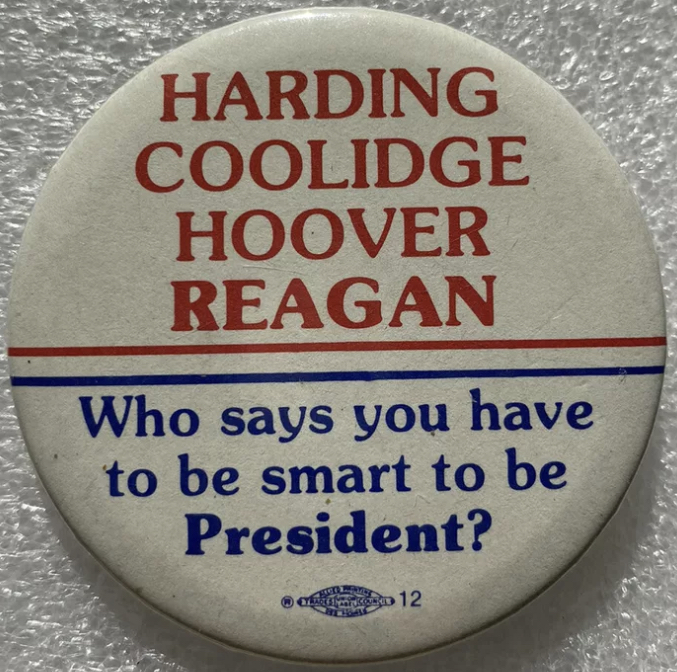
I was browsing eBay the other day and ran across an anti-Reagan political pin that said, “Harding. Coolidge. Hoover. Reagan. Who says you have to be smart to be President?” The attempt was to link Reagan with the Republican Presidents of the 1920s, inferring that Harding, Coolidge, and Hoover were incompetent and caused the Great Depression, and that Reagan, a graduate of Eureka College, would follow their example and bring on another economic calamity. It’s an oft-used play in the Democratic playbook: Tie every Republican to the dummies in the ‘20s.
But Warren Harding, all jokes aside, was no dummy. He got into the newspaper business in 1884, purchasing the Marion Star for $300 ($9,500 in 2024). After earning a very handsome living for nearly four decades, he sold it in 1923 for $550,000, about $10 million today.
Harding served in the state senate, as Lt. Governor, and as a US Senator from Ohio. He gave the nominating speech for William Howard Taft at the GOP convention in 1912 and was named the national convention chairman in 1916. In the Senate he served on the foreign relations committee, as part of a delegation that met with President Wilson in the White House to discuss the League of Nations, and was given the honor of giving the opening Senate speech opposing US entry into the League.
America in 1920, the year Harding was elected, fell into a serious economic slide called by some “the forgotten depression.” Coming out of the Great War and the disruptions of 1919, the economy struggled to adjust to peacetime realities, falling into a serious slump. Lasting about 18 months, from January 1920 to July 1921, conditions for average Americans steadily deteriorated. Industrial production fell by a third, stocks dropped nearly 50 percent, corporate profits were down more than 90 percent. Unemployment rose from 4 percent to 12, putting nearly 5 million Americans out of work.
The nation’s finances were also a train wreck. America had spent $50 billion on the Great War, more than half the nation’s GNP. The national debt jumped from $1.2 billion in 1916 to $26 billion in 1919, while the Allied Powers owed the US Treasury $10 billion. Annual spending soared more than twenty-five times, from around $700 million in 1916 to nearly $19 billion in 1919.
Harding campaigned on retrenchment. He slashed taxes, cut spending, halted foreign dumping, of both goods and laborers, and rolled back the progressive tide. He returned the country to fiscal sanity and economic normalcy. “We need a rigid and yet sane economy, combined with fiscal justice, and it must be attended by individual prudence and thrift, which are so essential to this trying hour and reassuring for our future,” he said in his inaugural address.
The business community expressed excitement about the Harding administration. The Wall Street Journal headlined on Election Day, “Wall Street sees better times after election.” The Los Angeles Times headlined the following day, “Eight years of Democratic incompetency and waste are drawing rapidly to a close.” “Harding’s Advent Means New Prosperity.” “Inauguration ‘Let’s Go!’ Signal to Business.”
The day after Harding’s inaugural, the Times editors predicted “good times ahead,” writing, “The inauguration … of President Harding and the advent of an era of Republicanism after years of business harassment and uncertainty under the Democratic regime were hailed” by the nation’s business leaders. I. H. Rice, the president of the Merchants and Manufacturers Association, told the press, “Good times are now ahead of us. Prosperity is at our door. We are headed toward pre-war conditions…. Business men are well pleased with President Harding’s selections for his Cabinet and by the caliber of men he has chosen we know that he means business.”
Under Harding, and his successor, Calvin Coolidge, and with the leadership of Andrew Mellon at the Treasury Department, taxes were slashed from more than 70 percent to 25. Spending was cut in half. Tariffs raised to stop European dumping and immigration cut to end the flood of cheap labor. The result was an economic boom. Growth averaged 7 percent per year, unemployment fell to less than 2 percent, and revenue to the government increased, generating a budget surplus every year, enough to reduce the national debt by a third. Wages rose for every class of American worker. It was unparalleled prosperity, unrivaled at any time since in American economic history.
After Coolidge decided against seeking another term in 1928, Herbert Hoover, succeeded him in the White House. Another myth from the Left is to link Hoover with Harding and Coolidge. But Hoover was not a conservative Republican; he was a progressive and not trusted by some of the most ardent purists in the party. But that doesn’t mean Hoover was dumb. He went to Stanford, became a highly successful mining engineer, and retired at an early age as a very wealthy man. In fact, he was the first President to donate his salary to charity. His mistake was trying to engineer the economy after the stock market crash in October 1929.
Many historians often say that Hoover did nothing about the depression, that he had maintained that they needed to “blow themselves out.” I remember one of my teachers saying that. Then I read Hoover’s memoirs. Here is what he actually said:
“No president before had ever believed there was a government responsibility in such cases. No matter what the urging on previous occasions, presidents steadfastly had maintained that the federal government was apart from such eruptions; they had always been left to blow themselves out. Presidents Van Buren, Grant, Cleveland, and Theodore Roosevelt had all remained aloof.” But, Hoover wrote, we “had to pioneer a new field.”
With the American economy sliding into a steep recession, Hoover proceeded to make things worse by intervening with activist government policies – increased spending, new agencies, reversing the Harding-Coolidge tax cuts (the top rate jumped from 25 percent to 63 percent in one fell swoop), and imposing the Smoot-Hawley tariff. By 1932, thousands of banks had closed and 20 million Americans were unemployed. The unemployment rate hit a staggering 25 percent in 1933. Industrial production fell 45 percent.
In 1932, Franklin D. Roosevelt ran against Hoover and actually lambasted him for his liberal policies. Whereas Harding was honest about his conservative prescriptions for the economy during his 1920 campaign, doing exactly what he said he would do, FDR deceived the public, campaigning on a more conservative agenda than what his predecessor, Herbert Hoover, had implemented. In fact, Roosevelt called for a 25 percent cut in federal spending and a balanced budget. FDR then did Hoover one better, or shall we say a lot better, in enacting his New Deal that, in the words of Amity Shlaes, is what made the depression great.
If Harding, Coolidge, and Hoover didn’t cause the depression, who, or what, did? As I wrote in Jazz Age President:
So, if laissez-faire didn’t cause the market to crash and the economy to fall into depression, then what did? Simply put, the Federal Reserve’s policies. As Ludwig von Mises has contended, almost every economic depression can be blamed on monetary policy. Throughout the 1920s, the Fed lowered interest rates, leading to increased speculation in the stock market, which created a bubble “fueled by the artificially cheap credit.” The Fed then began to raise interest rates in 1928 and 1929 in order to slow things down. They slowed them down too much. “In other words,” writes Robert Murphy, “when the Fed stopped pumping in gobs of new money that pushed up the stock market, investors came to their senses and asset prices plunged back towards their pre-bubble level.” The Great Depression had nothing to do with Warren Harding.
Or Calvin Coolidge or Herbert Hoover, for that matter.
What about Ronald Reagan? Did he crash the economy in the 1980s? Reagan inherited a mess left him by James Earl Carter. With Jimmy in office, America experienced a “misery index” for the first time. The country had an energy crisis, fuel shortages, double digit inflation (16 percent) and interest rates (20 percent), unemployment at 8 percent, and oil at $107 a barrel … in the 1970s! That would be a $400 barrel of crude today!
During Reagan’s two terms in office, in which he slashed taxes and regulations, the economy turned around: 20 million jobs were created, unemployment fell to 5.5 percent, inflation was cut to just 4 percent, middle class family net worth grew by 27 percent, the nation’s wealth grew 26 percent, interest rates were cut in half, and revenue to the government doubled.
But deficits were a problem throughout the Reagan years, as debt grew by more than $1.5 trillion. Yet much of that was due to the “Reagan Buildup,” a much-needed military boost and upgrade from years of use and misuse, and steep cuts by Carter, throughout the ‘70s.
Though Democrats try to run him down, the people were with Reagan, giving him two landslide victories, including his massive win for re-election in 1984 over Walter Mondale, Carter’s Vice President, who garnered just 13 electoral votes. In fact, Harding in 1920, Coolidge in 1924, Hoover in 1928, and Reagan in 1980 and 1984, all won by landslides.
Although we can excuse Hoover from this list, for his failed policies in addressing the economic crisis of 1929, if the economic record of Harding, Coolidge, and Reagan are considered failures, then let us have more failures in the White House.
 Ryan S. Walters
Leave a comment