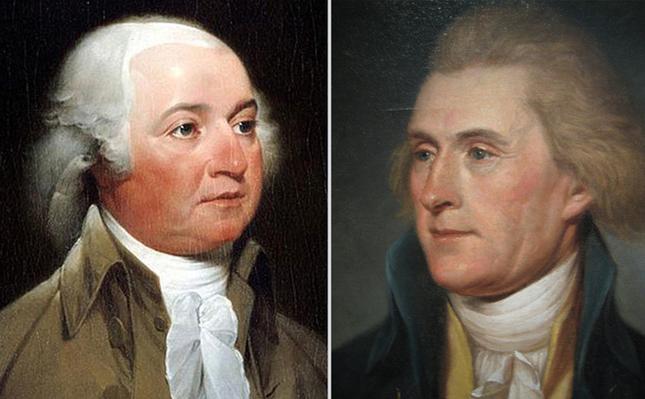
In just the last few months, former President Donald Trump has been indicted four separate times for actions surrounding the election of 2020 and the events of January 6. So far, he has amassed 91 separate charges in both federal and state courts. With most of the charges, if not all, being of questionable legality, if not downright silly, it is obvious that this is an attempt by corrupt Democrats to destroy their political opposition. But this is not a first in American history such a campaign to legally punish political opposition has been waged.
In the summer of 1798, the United States found itself in a “quasi war” with France, producing quite a bit of hysteria across the country. War seemed assured. Using the situation as an excuse to go after their political opponents, the Federalists in Congress passed four bills, collectively known as the Alien and Sedition Acts. Signed by President John Adams, the real purpose of the laws was to weaken Jeffersonian Republican opposition and punish political opponents of the administration, particularly newspaper editors who criticized the government. Of this we can be certain, since most of the bills contained a sunset provision, allowing them to expire after the 1800 presidential election, when they would no longer be needed.
The first law was the Naturalization Act, which raised from five years to fourteen years the period of residence required for citizenship. The reason for this was quite simple, as a majority of new immigrants from Europe were joining Jefferson’s party.
The second, the Alien Enemies Act, gave the President the authority to confine or deport aliens of an enemy country during a state of war. This is the only one of the four bills to receive some support from Republicans.
The third bill, the Alien Act, authorized the President to summarily deport any aliens, from whatever country, that he deemed dangerous “to the peace and safety” of the United States. These aliens (what we now call immigrants) would not receive a jury trial and the President was not required to explain or justify his decision. Jefferson considered the bill “worthy of the eighth or ninth century.” This act, like the Naturalization Act, was one of pure political partisanship.
The fourth, and most controversial, was the Sedition Act. It provided fines of up to $2,000 and jail sentences of up to two years for anyone who publicly criticized the President or other members of the government, by publishing “false, scandalous and malicious” accusations aimed at the federal government. It was a clear violation of freedom of speech and freedom of the press, codified in the Bill of Rights, then less than a decade old.
The Federalist leader of the House, Robert Goodloe Harper, stated that the purpose of the act was to protect the country from the enemy within – the Jeffersonian Republican Party, thereby preventing the United States from “being driven into a war with a nation (France) which openly boasts of its party among us (Jefferson’s Republicans).”
After the Senate passed the Sedition Act, ironically on July 4, 1798, Federalist leaders toasted the President: “John Adams. May he, like Samson, slay thousands of Frenchmen with the jawbone of Jefferson.” Federalist hatred of the author of the Declaration of Independence was total.
Under the Sedition Act, a number of Jeffersonian editors were charged, and those who were brought to trial were convicted, sent to prison and fined. One Republican made a public statement directed against the President while attending a ceremony in which Adams received a 21-gun salute, remarking that he wished the cannon fire would hit the President in his rear-end, and for that he received a $100 fine. Benjamin Franklin’s grandson and namesake, who was a Jeffersonian newspaper editor, was also arrested.
Perhaps the most notable conviction under the Sedition Act was Republican Congressman Matthew Lyon of Vermont, who gained notoriety some months before for publicly spitting in the face of a Federalist representative, Roger Griswold of Connecticut, on the floor of Congress. The Federalist majority sought to expel him from Congress, but fell short of the two-thirds required to do so. But he was charged under the Sedition Act for seditious libel against President Adams, and was prosecuted, found guilty, and received a fine of $1,000 and a four-month jail sentence. Incidentally, he was re-elected to Congress while in prison.
Jefferson, though Vice President at the time, was extremely upset over the Alien and Sedition Acts and the conduct of the Adams Administration. The Republicans, though, responded, not with compromise, but outright opposition. Acting secretly, for fear of arrest, Republicans passed two sets of resolutions, sponsored by two Southern states – the Kentucky and Virginia Resolutions, written by Jefferson and James Madison respectively.
These resolutions argued that whenever the federal government overstepped its constitutional bounds, as it had done with the Alien and Sedition Acts, it was up to the states to interpose their authority and to nullify or block enforcement of the law. “The several states who formed that instrument [the Constitution], being sovereign and independent, have the unquestionable right to judge of its infraction; and that a nullification, by those [states], of all unauthorized acts….is the rightful remedy,” Jefferson wrote.
The Alien and Sedition Acts, though, proved to be a bridge too far for most Americans. The Republicans prevailed in the elections in 1800, winning the House and Senate, with Jefferson becoming President. Once in power in 1801, Republicans quickly repealed the Alien and Sedition Acts or allowed them to expire. Jefferson immediately pardoned those who had been prosecuted, ordered the release of those still incarcerated, and returned fine money to them.
The Federalists paid a very heavy price for their treachery. The American people made sure they never held power again, and by 1816 they were no more.
 Ryan S. Walters
Leave a comment