One century ago, on August 2, 1923, President Warren G. Harding’s life came to a sudden end. But over the course of the next 100 years, many Americans have come to see the 29th President as one of the worst chief executives the nation has ever had.
In the immediate years after his death, news of a major scandal, Teapot Dome, began to leak out, as did problems in the Justice Department and the Veterans Bureau. But one cannot blame the American people for seeing in Harding a scandalous President. For all the people knew, and had heard in the press, was news that these three scandals plagued Harding’s administration, not knowing the full nature of those scams and the fact that Harding himself had nothing to do with them. In fact, he had done something about those he was aware of. People were fired and prosecuted. Unfortunately, the President passed away before he could deal with Teapot Dome.
Florence Harding was the first to begin the process of rehabilitating the legacy of her husband. But unfortunately, the former First Lady died the following year and could do little to protect his rightful place in history.
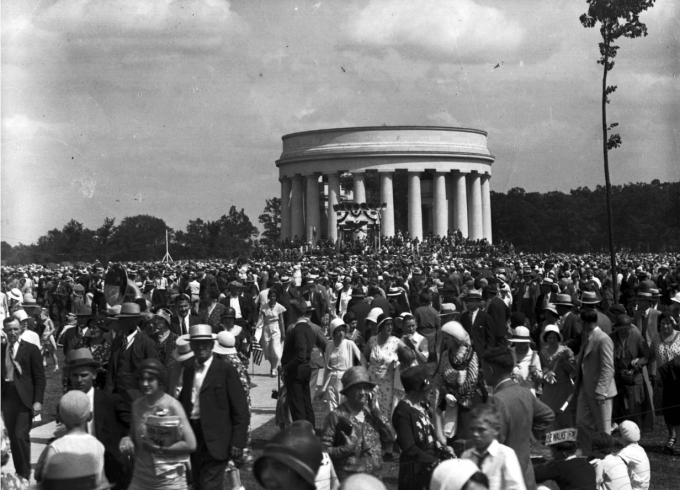
The first major effort at rehabilitating Harding’s tarnished image came from his former Commerce Secretary, Herbert Hoover, who in 1931, was the President of the United States. A memorial had been erected in Marion, Ohio, Harding’s hometown, to permanently entomb his remains, along with those of the First Lady. It was completed in 1927. But Calvin Coolidge, who was President at the time, would not travel to Marion for a dedication ceremony. According to Hoover, President Coolidge “expressed a furious distaste and avoided it” because it was “a great political liability.”
But Hoover had a different attitude toward his former boss. “When I became President,” wrote Hoover in his memoirs, “I felt that I should return Harding’s kindness to me and do it. I eulogized his good qualities and took a slap at the friends who had betrayed him. None of them came to the dedication.”
On June 16, 1931, President Hoover spoke at the official dedication of the Harding Memorial in Marion. Praising Harding, who had fought his own party to bring him into the Cabinet, Hoover displayed a grateful heart. His speech, in celebration of a man with “a kindly and gentle spirit” who “came from the people,” was a testament to all that Warren Harding had accomplished as President.
Hoover first recognized the extraordinary difficulties plaguing the nation when Harding first stepped into the presidential chair. “As the aftermath of war our national finances were disorganized, taxes were overwhelming, agriculture and business were prostrate, and unemployment widespread. Our country was torn with injustices to those racial groups of our own citizens descended from the enemy nations. Violent bitterness had arisen over the Treaty of Versailles,” he reminded his audience. “These evil spirits aroused by war, augmented by inestimable losses, deep animosities, the dislocations of industry, the vast unemployment in a world still armed and arming confronted Warren G. Harding.”
In the immediate aftermath of the war the nation needed healing and Warren Harding was the perfect man for the job, one who possessed “the healing quality of gentleness and friendliness,” he said. “When in 2 years he died, new peace treaties had been made in terms which won the support of our people; tranquility had been restored at home; employment had been renewed and a long period of prosperity had begun.”
In foreign affairs, the “Washington Arms Conference for the reduction and limitation of battleships identified his administration with the first step in history toward the disarmament of the world. That step was accompanied by the momentous treaties which restored good will among the nations bordering upon the Pacific Ocean and gave to all the world inestimable blessings of peace and security.”
On the domestic front, the “reorganization and reduction of the public debt, the reduction in taxation, the creation of the budget system, the better organization of industry and employment, new services to agriculture, the establishment of a permanent system of care for disabled veterans and their dependents.”
Though his administration was tarred with scandal, that should not tarnish Warren Harding, Hoover said. On the trip west in 1923, “We saw him gradually weaken not only from physical exhaustion but from mental anxiety. Warren Harding had a dim realization that he had been betrayed by a few of the men whom he had trusted, by men whom he had believed were his devoted friends. It was later proved in the courts of the land that these men had betrayed not alone the friendship and trust of their staunch and loyal friend but they had betrayed their country. That was the tragedy of the life of Warren Harding.”
Hoover’s last point was shared by some of Harding’s closest confidants. TR’s eldest daughter, Alice Roosevelt Longworth, wrote, “He had discovered what was going on around him, and that knowledge, the worry, the thought of the disclosures and shame that were bound to come, undoubtedly undermined his health – one might say actually killed him.”
Calvin Coolidge agreed. “I do not know what had impaired his health. I do know that the weight of the presidency is very heavy. Later it was disclosed that he had discovered that some whom he had trusted had betrayed him and he had been forced to call them to account. It is known that this discovery was a very heavy grief to him, perhaps more than he could bear.”
Indeed, the Akron Beacon Journal in Ohio opined on Harding’s death that “one’s heart rebels and even in this hour of sorrow asks whether it was the decree of fate or the foolishness of friends that has sent this great American to an untimely end.” Now, it is only time that “will fix his place in history for the rest of the world.”
Perhaps now is the time.
 Ryan S. Walters
Leave a comment